
SOH FOUNDATION
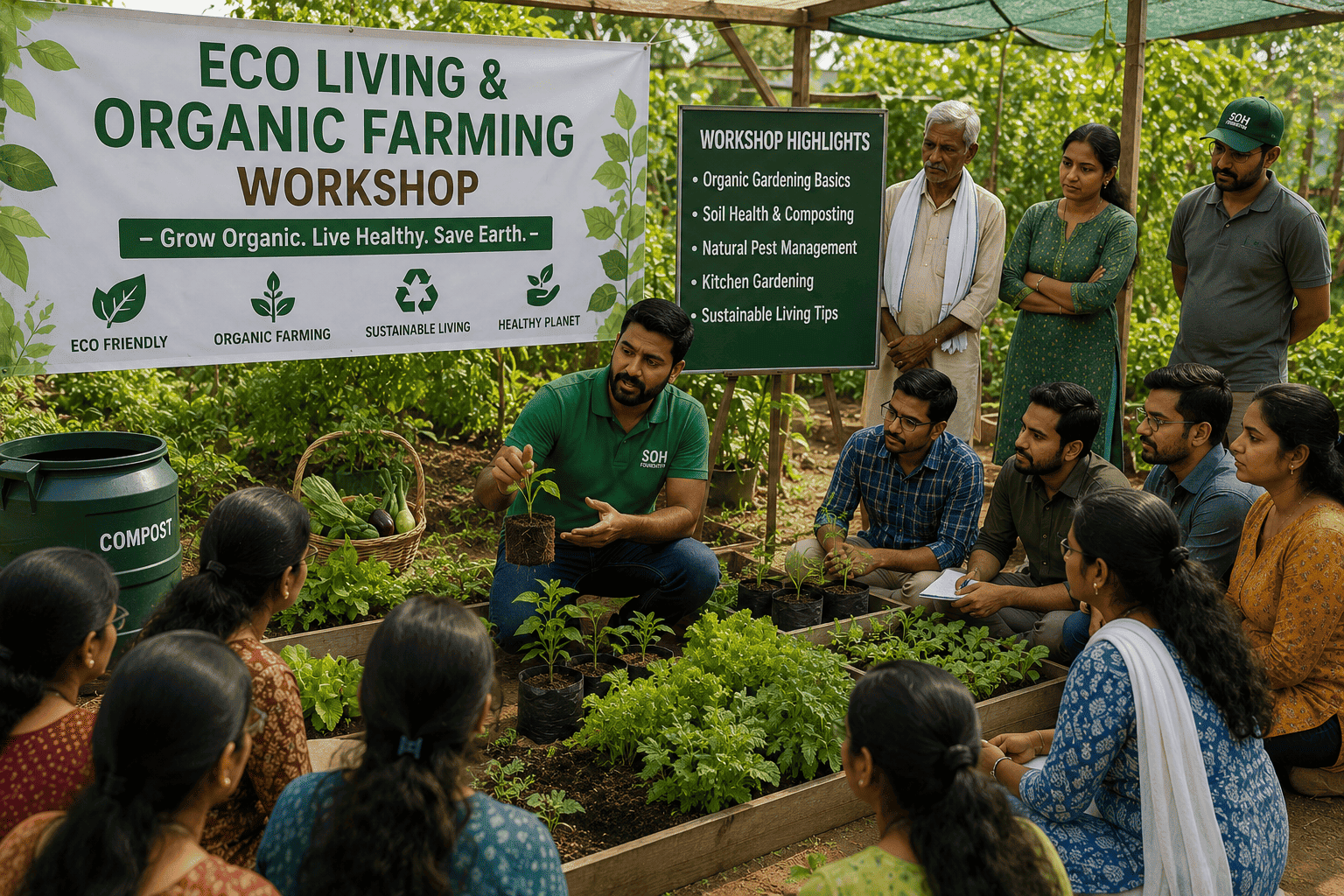
Eco Living & Organic Farming Workshop
Eco Living & Organic Farming Workshop
The Eco Living & Organic Farming Workshop is designed to encourage individuals, families, farmers, and communities to explore practical ways of living more sustainably while developing a deeper understanding of natural and responsible farming practices. The workshop brings together the ideas of environmental conservation, organic cultivation, resource efficiency, healthy living, and community participation.
Our everyday choices influence the environment around us. From the food we consume and the waste we generate to the way we use water, soil, energy, and other natural resources, small decisions can collectively create a significant impact. Through practical learning and awareness, this workshop encourages participants to understand these connections and adopt environmentally responsible practices that can become part of everyday life.
Understanding Eco-Friendly Living
Eco-friendly living begins with becoming more conscious of how we use resources. The workshop introduces participants to practical approaches that can help reduce unnecessary consumption, minimise waste, conserve natural resources, and create healthier living environments.
Participants are encouraged to examine their daily habits and identify simple changes that can contribute towards sustainability. These may include reducing disposable materials, reusing available resources, managing household waste responsibly, conserving water, avoiding unnecessary wastage, and making thoughtful choices about the products and materials used in everyday life.
Learning the Principles of Organic Farming
Organic farming focuses on cultivating crops while giving careful attention to soil health, ecological balance, natural resources, and responsible agricultural practices. The workshop introduces participants to the fundamental ideas behind organic cultivation and encourages a better understanding of farming methods that work more closely with natural processes.
Participants can explore topics such as soil preparation, composting, organic inputs, crop planning, natural methods of supporting plant health, responsible water usage, and the importance of maintaining healthy agricultural ecosystems.
The objective is to make sustainable cultivation easier to understand and encourage participants to consider how appropriate practices can be applied according to their land, resources, environment, and local conditions.
Building Healthy and Productive Soil
Healthy soil forms the foundation of productive and sustainable agriculture. The workshop highlights the importance of protecting soil structure, maintaining organic matter, and supporting the natural processes that contribute to soil fertility.
Participants are introduced to practical concepts such as composting, recycling biodegradable organic material, maintaining soil cover, and improving soil health through responsible cultivation practices.
By understanding soil as a living and valuable natural resource, participants can develop greater awareness of why long-term soil care is essential for sustainable food production.
Turning Organic Waste into a Resource
Biodegradable waste from kitchens, gardens, farms, and other suitable sources can often be managed more responsibly instead of simply being discarded. Composting provides an opportunity to transform appropriate organic material into a useful resource for gardens and agricultural soil.
The workshop encourages participants to understand the basic principles of composting, segregation of suitable organic materials, and responsible waste management. This creates an important connection between sustainable living and farming by demonstrating how resources can be reused within a natural cycle.
Promoting Responsible Water Management
Water is one of the most valuable resources for both households and agriculture. Responsible water management is therefore an important part of sustainable living and farming.
The workshop encourages participants to understand the importance of avoiding unnecessary water wastage, improving irrigation practices where appropriate, maintaining soil moisture, and exploring practical conservation methods suitable for local conditions.
Developing greater awareness about water usage can help communities appreciate its value and encourage more responsible management of this essential natural resource.
Encouraging Home and Community Gardening
Sustainable cultivation does not always require large agricultural land. Depending on available space and local conditions, individuals can explore growing suitable plants, herbs, vegetables, or other crops in home gardens, terraces, community spaces, or small plots.
The workshop encourages participants to understand the basic requirements of plants, including appropriate soil, sunlight, water, nutrition, and regular care.
Home and community gardening can also create opportunities for families, children, and neighbours to participate in cultivation and develop a closer relationship with food and nature.
Connecting Food with Sustainable Living
The journey of food from soil to plate involves natural resources, human effort, transportation, storage, and preparation. Understanding this journey can encourage people to value food more deeply and reduce unnecessary wastage.
The workshop promotes awareness about responsible food consumption, seasonal and locally appropriate choices where possible, careful meal planning, and better management of food waste.
By understanding the connection between agriculture, food, health, and the environment, participants can make more informed choices in their everyday lives.
Reducing Waste and Reusing Resources
Sustainable living encourages us to rethink the idea of waste. Many items that are discarded may be reusable, recyclable, repairable, or capable of serving another purpose.
Participants are encouraged to adopt practical habits such as reducing unnecessary purchases, reusing materials wherever appropriate, separating different types of waste, recycling responsibly, and avoiding excessive dependence on disposable products.
These simple practices can help reduce pressure on natural resources while encouraging a more thoughtful approach to consumption.
Learning Through Practical Participation
The Eco Living & Organic Farming Workshop places importance on practical understanding. Participants are encouraged to observe, ask questions, exchange experiences, and explore techniques that may be useful in their own homes, gardens, farms, or communities.
Hands-on learning can make sustainability easier to understand by connecting environmental concepts with everyday activities. The goal is to help participants leave the workshop with ideas that can realistically be adapted and practised over time.
Encouraging Sustainable Livelihood Opportunities
Knowledge related to organic cultivation and sustainable practices may also create opportunities for livelihood development. Depending on individual skills, resources, and local demand, participants may explore possibilities connected with farming, nurseries, composting, gardening, agricultural products, local food initiatives, or other environmentally responsible activities.
The workshop encourages participants to think creatively about how sustainable practices can support both environmental responsibility and economic opportunity while remaining appropriate to local circumstances.
Involving Families and Communities
Environmental responsibility becomes stronger when it is shared. The workshop encourages participants to take sustainable ideas beyond the programme and introduce practical habits within their families and communities.
When households begin conserving resources, reducing waste, growing plants, protecting soil, and sharing knowledge with others, individual actions can gradually contribute towards broader community awareness.
Community participation can also create opportunities for shared gardens, plantation activities, composting initiatives, cleanliness programmes, and other locally relevant environmental efforts.
Building a Stronger Connection with Nature
Modern lifestyles can sometimes create distance between people and the natural systems that support everyday life. Growing food, caring for soil, conserving water, planting trees, and observing natural cycles can help rebuild that connection.
The workshop encourages participants to recognise that human well-being and environmental well-being are closely connected. Protecting natural resources is therefore not only an environmental responsibility but also an investment in the quality of life of present and future generations.
Growing Towards a Sustainable Future
The Eco Living & Organic Farming Workshop is an opportunity to transform environmental awareness into practical everyday action. By learning about organic cultivation, soil care, water conservation, waste management, responsible consumption, and sustainable living, participants can identify meaningful changes that are suitable for their own circumstances.
The objective is not to change everything overnight, but to encourage consistent and responsible choices that gradually become part of everyday life. Every garden created, every resource conserved, every piece of waste responsibly managed, and every sustainable practice shared with another person can contribute towards positive environmental change.
By learning to live responsibly and grow in harmony with nature, we can cultivate more than healthy soil and food — we can help build healthier communities and a more sustainable future for generations to come.